Reservation
Online
Integer congue malesuada eros congue varius. Sed malesuada dolor eget velit pretium. Etiam porttitor finibus. Nam suscipit vel ligula at dharetra
Error: Contact form not found.
Integer congue malesuada eros congue varius. Sed malesuada dolor eget velit pretium. Etiam porttitor finibus. Nam suscipit vel ligula at dharetra
Error: Contact form not found.

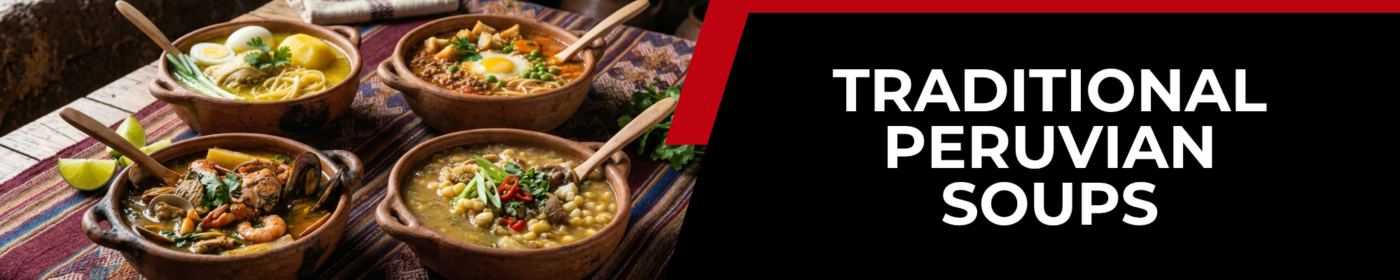
Peru is known around the world for its rich and diverse gastronomy.
While many travelers immediately think of dishes like ceviche or lomo saltado, there is another essential part of Peruvian cuisine that often goes unnoticed:
Across the country, from the coast to the Andes and the Amazon, soups play a fundamental role in daily life. They are not just starters — they are complete meals, deeply connected to tradition, climate, and culture.
For those exploring what to eat in Peru, discovering these soups is an experience you should not miss.
In Peru, soups are more than simple dishes.
They are designed to nourish, energize, and adapt to the environment.
In the Andes, where temperatures can be low and conditions demanding, soups are often thick, warm, and highly nutritious. In coastal and Amazon regions, they reflect local ingredients and cooking traditions.
Many of these recipes have been passed down through generations, preserving techniques that date back to pre-Columbian times.
One of the most representative styles of Peruvian soups is the chupe.
A chupe is a hearty, dense soup prepared with a variety of ingredients such as potatoes, corn, grains, dairy, and protein.
These soups are designed to be complete meals, offering both comfort and nutrition.
One of the most iconic examples is chupe de camarones, a traditional dish from Arequipa made with river shrimp, milk, cheese, eggs, and Andean vegetables.
This dish perfectly reflects the fusion of ancient Andean ingredients with Spanish influences, creating one of the most beloved flavors in southern Peru.
Another powerful example of Andean soups is caldo de cabeza.
This traditional preparation, made from sheep or lamb head, reflects the Andean principle of using every part of the animal.
Slow-cooked and deeply nourishing, it is commonly enjoyed in the mornings in local markets.
Beyond its flavor, caldo de cabeza is also associated with traditional stories and symbolism, particularly in wedding customs, where different parts of the dish represent guidance, wisdom, and the importance of listening.
It is one of the most authentic ways to experience Andean food culture.
Among the most traditional soups of the Andes, patasca stands out for its history and cultural importance.
This hearty soup is prepared with mote (large Andean corn), beef, and often panza de res (tripe), which gives the dish its distinctive texture and depth of flavor.
The use of mote connects patasca to pre-Columbian times, when corn was a central element of Andean nutrition. Over time, the incorporation of beef and tripe reflected the evolution of the dish during the colonial period.
Preparing patasca requires time and care. The ingredients are slowly simmered, allowing the flavors to fully develop into a broth that is both light in appearance but deeply nourishing.
Traditionally served during early mornings, festivals, and community gatherings, patasca is more than just food — it is a symbol of shared culture and tradition in the Andes.
Peru offers a wide variety of soups, each with its own identity and regional character.
Some of the most popular include:
Each of these dishes reflects the diversity of ingredients and traditions that define Peruvian gastronomy.
The importance of soups in Peru is so significant that entire restaurants are dedicated to them.
One of the most well-known examples is Siete Sopas, a popular restaurant concept where each day of the week features a different traditional soup.
This reflects how deeply soups are embedded in everyday life, not only as traditional dishes but also as part of modern urban food culture.
For travelers, soups offer one of the most authentic ways to connect with local culture.
They are often found in markets, small eateries, and traditional kitchens — places where recipes are still prepared as they have been for generations.
Trying these soups is not only about tasting new flavors, but about understanding how geography, history, and culture come together in every dish.
Peruvian cuisine is built on diversity, and soups are one of its strongest expressions.
From the dense and nourishing chupes of the Andes to the bold flavors of coastal broths, each bowl tells a story.
For food lovers exploring Peruvian food experiences, these dishes offer something truly special: a deeper connection to the country.
Cook, Learn, Enjoy and Taste Peru!
Comments are closed.